Era Uma Vez
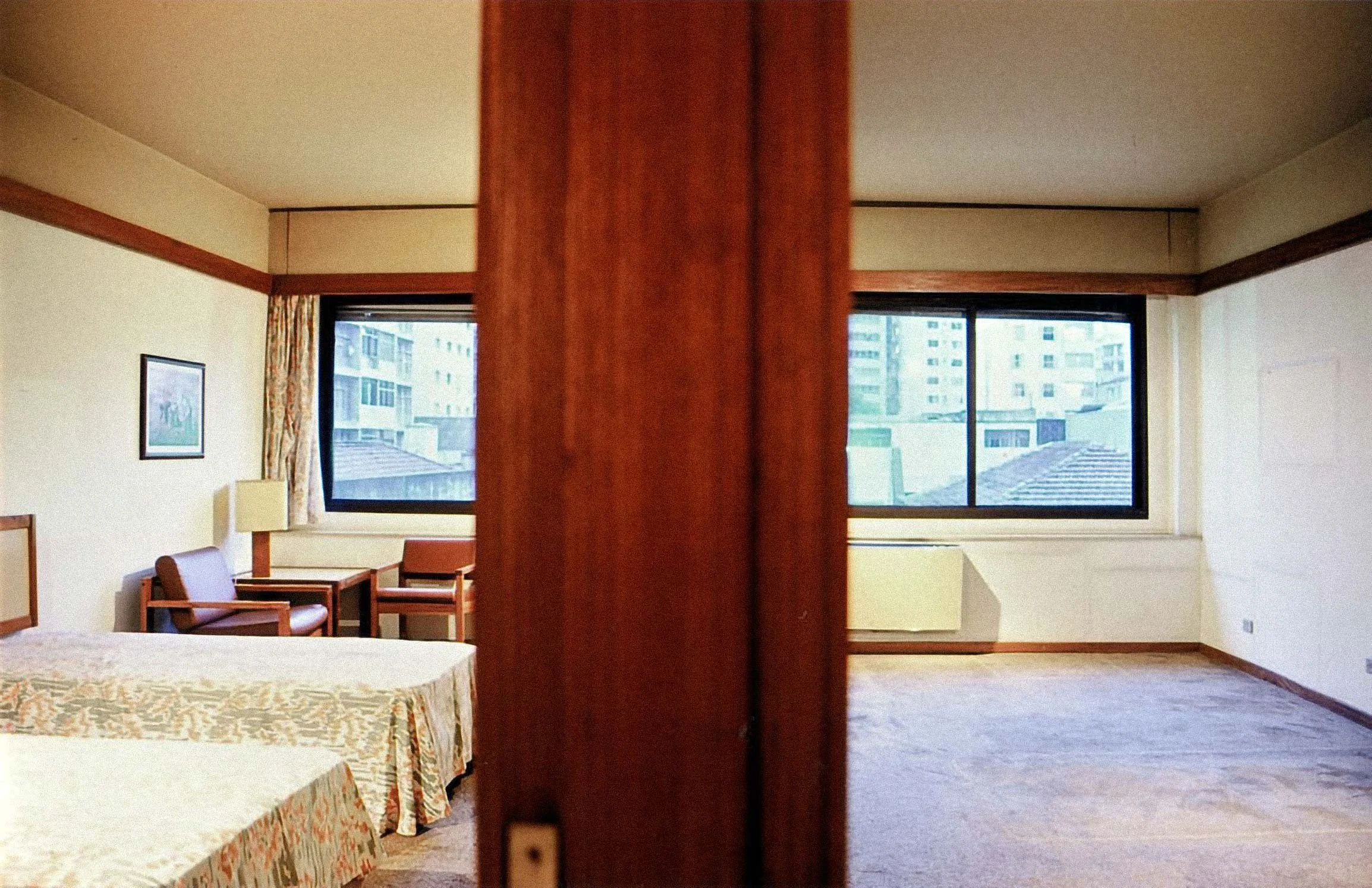
The installation occupies two contiguous rooms, articulated by an open connecting doorway that establishes a field of tension between presence and absence. In one room, the furniture and framed works remain in their original state; in the other, everything has been removed, leaving only the furniture's imprints on the carpet and the pictures' imprints on the walls. The viewer is invited to stand at the threshold, a liminal position that allows the simultaneous perception of both spatial conditions — the furnished and the emptied, what endures and what has vanished.
These material traces operate as indices of time and loss, revealing the wear and decay of the Hotel Lord Palace, a place whose aura has dissipated. What remains is not intact memory, but its silent inscriptions — marks that testify to a history that persists only as residue. Once Upon a Time… thus constructs a narrative through absence, transforming space into a witness to what was and is no longer, and activating a reflection on memory, erasure, and the fragility of permanence.
A instalação ocupa dois quartos contíguos, articulados por uma porta mantida aberta, instaurando um campo de tensão entre presença e ausência. Em um dos ambientes, os móveis e quadros permanecem em seu estado original; no outro, tudo foi removido, restando apenas as marcas impressas no tapete e nas paredes. O espectador é convocado a permanecer na soleira, posição liminar que permite apreender simultaneamente os dois estados do espaço — o cheio e o esvaziado, o que permanece e o que já se foi.
Esses vestígios materiais operam como índices do tempo e da perda, revelando o desgaste e a decadência do Hotel Lord Palace, um lugar cuja aura se dissolveu. O que subsiste não é a memória intacta, mas suas inscrições silenciosas, sinais de uma história que persiste apenas como rastro. Era uma vez… constrói, assim, uma narrativa a partir da ausência, onde o espaço se torna testemunho do que foi e já não é, ativando uma reflexão sobre memória, apagamento e a precariedade das permanências
LORD PALACE HOTEL
intervenções
Inaugurado em novembro de 1958 e fechado em maio de 2004, Lord Palace Hotel reabre suas portas em 18/09/04 sob nova administração, totalmente remanejado por ações, instalações, fotografias e vídeos de artistas. São diversas intervenções, pensadas especificamente para o espaço desse antigo hotel paulistano, localizado na região central da cidade. Em estreita relação com o contexto urbano em que o Hotel está inserido e espelhando a localização central do edifício, a exposição LORD PALACE HOTEL promove um cruzamento de artistas e linhas de trabalho de várias procedências. Artistas que, após seis meses de encontros e discussões em torno do imaginário e do conceito do Hotel como lugar de passagem, desarrumaram e rearranjaram seus usos e funções, propondo novas ocupações para o lobby, escadas, andares e corredores.
acompanhamento crítico:
Cauê Alves
Juliana Monachesi
Paula Alzugaray
LORD PALACE HOTEL
Interventions
Inaugurated in November 1958 and closed in May 2004, the Lord Palace Hotel reopened its doors on September 18, 2004, under new management and entirely reconfigured through actions, installations, photographs, and videos by invited artists. The exhibition brings together a series of interventions conceived specifically for the spaces of this former hotel in downtown São Paulo.
Closely connected to the urban context in which the building is embedded, and reflecting its central location within the city, LORD PALACE HOTEL promotes a crossing of artists and practices from diverse backgrounds. After six months of meetings and discussions around the hotel’s imaginary and its condition as a place of passage, the participating artists disrupted and reconfigured its uses and functions, proposing new forms of occupation for the lobby, staircases, floors, and corridors.
Critical accompaniment:
Cauê Alves
Juliana Monachesi
Paula Alzugaray